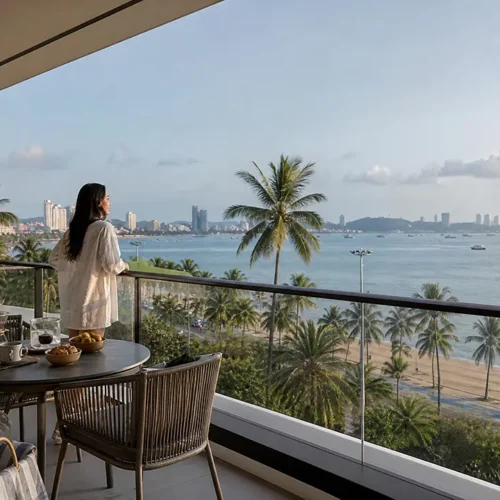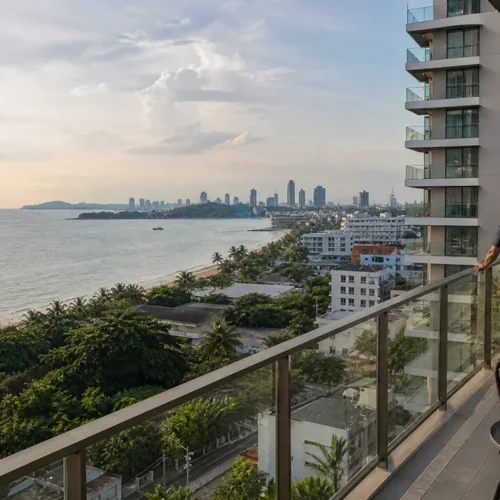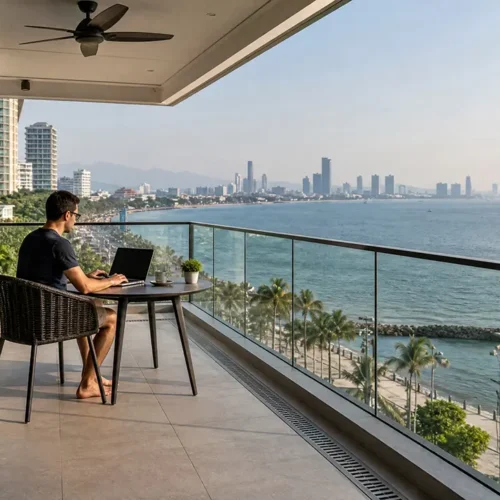








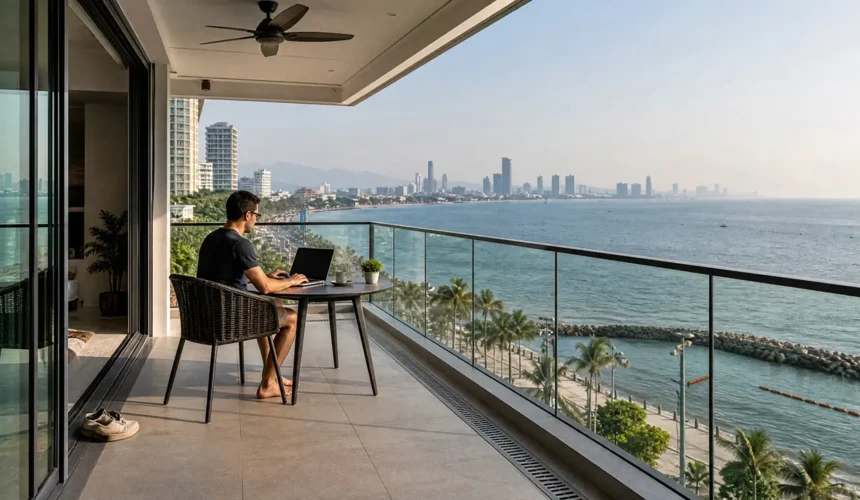
Living in a beachfront condo in Pattaya can make ordinary routines feel more open: a morning walk, a balcony coffee, or a short reset after work. The trade-off is that coastal exposure is a building-care issue as well as a lifestyle choice. Humidity, salt-laden air, strong sun, wind-driven rain, privacy, and transport patterns should be assessed alongside views and interiors. This guide explains what can reasonably be expected, what must be checked in the project or unit under consideration, and how to care for a sea-facing home over the long term.
Introduction: what “by the sea” changes in daily life
A more usable outdoor routine
A sea-facing setting can make short outdoor breaks feel worthwhile. Professionals and remote workers may value a balcony or shared outdoor area as a visual change from a screen. Families may appreciate an easy route to the waterfront, subject to safe crossings, shade, and supervision. Retirees may value a daily walking habit, but should inspect pavement quality, slopes, seating, lighting, and the distance to groceries and healthcare rather than assuming that a beach address is automatically walkable.
The benefit is habit formation: when the outdoor option is close, residents may use it more often. Yet the experience depends on heat, rain, traffic, public activity, and the exact entrance route. Visit at different times before drawing conclusions.
Natural light, airflow, and a sense of space
A clear outlook can improve the perceived spaciousness of a smaller home. Cross-ventilation may help where a unit has openings on more than one side, but layouts vary and windows may be fixed, restricted, or exposed to driving rain. Ask how windows, doors, exhaust fans, and air-conditioning work in the unit under consideration.
Pattaya’s official weather information shows the conditions that make moisture management relevant: one current TMD reading displayed 31.8°C, a 25.8°C dew point, and 71% relative humidity, while its weekly outlook showed rain on several days. A weather snapshot is not a long-term climate average, but it is a useful reminder that coastal comfort and indoor moisture control are linked.
Convenient regional access, with local caveats
Pattaya also has connections beyond the city. The Government Public Relations Department reported in 2025 that the Suvarnabhumi–Pattaya bus service offered eight round trips daily with a journey time of around two hours; schedules should be rechecked before travel. U-Tapao Rayong–Pattaya International Airport provides passenger and public-transportation information on its official site.
This does not mean every beachfront address is equally convenient. A short route to the beach may be less useful if the entrance is difficult for a stroller, wheelchair, groceries, or luggage. Compare door-to-road access, parking, taxi availability, and routes to work, school, supermarkets, and medical services.
The trade-offs: humidity, salt, sun, noise, and privacy
Sea air is comfortable, but moisture is persistent
Warm, humid air can make interiors feel sticky, slow drying, and cause condensation on cool surfaces. The Centers for Disease Control and Prevention recommends keeping home humidity no higher than 50% where practicable. The U.S. Environmental Protection Agency advises below 60%, ideally 30%–50%, and drying wet areas quickly.
These are general recommendations, not a promise that every Pattaya unit can maintain a particular reading. Use a hygrometer in bedrooms, wardrobes, bathrooms, and the sea-facing room. If a unit is left closed, arrange inspections and air-conditioning or dehumidification rather than relying on occasional airing.
Salt exposure increases the importance of inspection
Salt-laden air and humidity can accelerate corrosion of exposed metal, fasteners, railings, air-conditioning components, door hardware, and some outdoor fixtures. The U.S. Whole Building Design Guide describes waterfront environments as severe atmospheric-corrosion zones and identifies salt spray, humidity, rain, moisture, and chloride-containing environments as contributing factors. A residential tower is not a naval pier, but the underlying maintenance principle is relevant: exposure increases the value of good material selection, protective coatings, drainage, inspection, and prompt repair.
Look for rust staining, bubbling paint, pitted hardware, powdery concrete edges, deteriorated sealant, damp balcony corners, blocked drains, and air-conditioner corrosion. Ask how the juristic person records and addresses defects. The answer should be documented, not inferred from a polished lobby.
Sun, wind, rain, and noise affect comfort
An open outlook can bring more sun and wind than expected. Glare may affect remote-work screens, and heat gain may increase air-conditioning use. Wind-driven rain can reach balcony furniture, sliding-door tracks, and thresholds. Road traffic, events, and neighboring balconies can affect noise and privacy.
Privacy is easy to overestimate from listing photographs. Check sightlines from adjacent towers, shared areas, corridors, lifts, and public spaces. Stand on the balcony with curtains open, and visit at a busy time and at night. Ask whether the view is direct, angled, or partial, and whether it is contractually guaranteed.
Long-term condo care: a simple operating system
A coastal home is easier to maintain when care is scheduled rather than reactive. The project’s common-area plan matters as much as the owner’s routine because façades, roofs, drainage, lifts, pumps, fire systems, and shared waterproofing are usually managed collectively. Review rules, budgets, repair history, reserve or sinking-fund arrangements, insurance, and juristic-person meeting records where available.
Inside the unit, keep balcony drains and door tracks clear, clean exposed surfaces appropriately, and inspect sealants and wet areas. Service air-conditioning units and confirm that condensate lines drain correctly. Use exhaust fans as designed and do not block ventilation grilles.
WHO guidance identifies persistent dampness and microbial growth as conditions to prevent, with ventilation and moisture control central. If you see mould, musty smells, recurring condensation, or paint failure, fix the moisture source rather than simply repainting. Use a qualified professional for significant damage or suspected concealed mould.
Practical step-by-step actions before choosing a unit
- Define the routine first. List work calls, school runs, exercise, shopping, medical visits, and airport trips. Decide what should be walkable and what can require a vehicle.
- Inspect conditions, not only finishes. Open windows and doors, run exhaust fans, check bathroom corners, and examine balcony drainage and air-conditioning condensate.
- Measure comfort. Bring a hygrometer, note temperature and humidity, listen for traffic and mechanical noise, and observe glare and wind. Repeat the visit after rain if possible.
- Test privacy and access. Stand in the living room and balcony, look toward neighboring buildings, and walk from parking or drop-off to the lift. Assess crossings, shade, and lighting.
- Request building records. Ask for maintenance schedules, major repairs, common fees, reserve or sinking-fund information, insurance, rules, and known water-ingress or façade issues.
- Confirm legal and financial facts. For a purchase, have an independent Thai property lawyer or other qualified adviser review title, registration, encumbrances, transfer costs, taxes, foreign-ownership eligibility, and the project’s quota position. Do not treat this article as legal advice.
- Plan the first year of care. Budget for air-conditioning service, cleaning, sealant checks, solar control, dehumidification, and inspections if the unit will be vacant.
FAQ: living in a beachfront condo in Pattaya
01.
Is sea air always good for your health?
No. A coastal setting may support outdoor routines and enjoyment of daylight, but it does not guarantee cleaner air or a health benefit. Check current conditions and consider personal sensitivities.
02.
Does a sea-view condo need more maintenance?
Often, exposed elements may need closer inspection because humidity, salt, sun, wind, and rain can affect metal, sealants, coatings, drainage, and air-conditioning components. The actual burden depends on design, materials, location, and the building’s maintenance quality.
03.
How can I reduce mould risk in a Pattaya condo?
Na Jomtien is commonly discussed with the greater Pattaya coastal area, but administrative Control moisture, keep indoor humidity low, use bathroom and kitchen exhaust, maintain air-conditioning drainage, dry wet areas promptly, and investigate leaks or condensation. CDC and EPA guidance emphasizes fixing the moisture source as well as cleaning visible mould.
04.
Is a beachfront condo private?
Not necessarily. Privacy depends on tower spacing, floor, orientation, balconies, public activity, and neighboring sightlines. Inspect the unit at multiple times and do not rely only on listing photographs.
05.
Can I live comfortably in Pattaya without a car?
Possibly, but it depends on the exact location and your routine. Review walking conditions, ride-hailing and taxi access, local transport, groceries, healthcare, and airport connections. Confirm current routes and schedules before committing.
06.
Can foreigners own a condominium in Thailand?
Thailand’s government information states that, under the Condominium Act 1979, foreigners may own up to 49% of the total units in a registered condominium building, subject to the applicable procedure and documentation. Eligibility, quota, funds, title, and transfer details must be checked for the specific unit with qualified legal and land-office professionals.
07.
Does a sea view guarantee a good investment or rental return?
No. A view may influence demand, but returns depend on price, fees, taxes, vacancy, management, competition, regulations, and market conditions. No rental or investment outcome should be guaranteed from a view alone.
Conclusion
Living in a beachfront condo in Pattaya can offer a more outdoor-oriented rhythm, an expansive outlook, and convenient access to coastal leisure. The honest trade-off is operational: humid air requires moisture control, salt exposure rewards preventive maintenance, open views can reduce privacy, and a beach address does not automatically solve everyday mobility. Evaluate the project and the unit under consideration as a complete system—building records, ventilation, drainage, privacy, access, legal documents, and your own weekly routine.
If you would like a calm, fact-checking conversation about a particular project or unit, Beachfront Condo Pattaya can help you arrange a viewing and identify which details should be verified before you make a decision.